
Remembering Those Who Have Left Us.
Throughout my life, I’ve had to say goodbye to several beloved souls: dear friends and faithful companions alike. Among them was my dog Peppa, who left her body three years ago. She was more than a pet; she felt like a child. Even today, when I see old pictures of us together, I still feel that wave of grief and tenderness rise within me.
Earlier this year, I also said goodbye to a dear friend and spiritual companion from my Sangha, as well as to a good old acquaintance who had opened many doors for me in the past. Each loss brought its own depth of silence, that feeling as if the ground beneath your feet has suddenly vanished. You feel powerless, helpless, lost. You miss the being that meant so much to you.
Creating “Awakening in Death”
From these experiences of loss and longing, Awakening in Death was born. The track is based on one of the most profound verses of the Bhagavad Gita (2.20), which reminds us of the soul’s eternal nature:
na jāyate mriyate vā kadāchin
nāyaṁ bhūtvā bhavitā vā na bhūyaḥ
ajo nityaḥ śhāśhvato ’yaṁ purāṇo
na hanyate hanyamāne śharīre
The soul is neither born, nor does it ever die; nor having once existed, does it ever cease to be.
The soul is without birth, eternal, immortal, and ageless.
It is not destroyed when the body is destroyed.
The track begins with a slow, heavy pulse, carrying the weight of grief and parting, and gradually becomes lighter and more playful until the sound itself dissolves into silence. Just like life: dense, intense, transformative, and finally merging back into stillness.
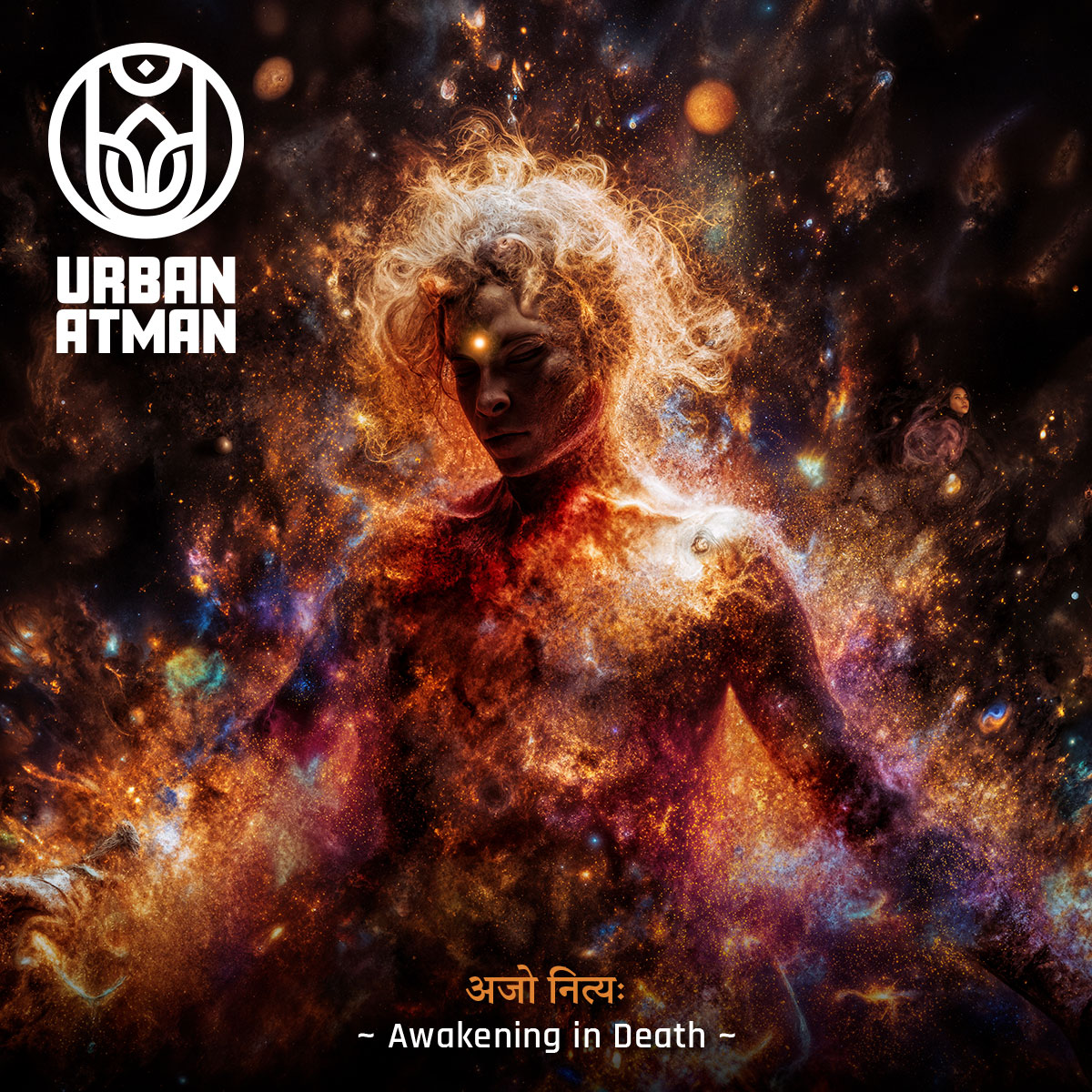
Download the track for free on bandcamp in various formats.
No subscription needed!
Facing Death in Western Culture
In the West, we rarely face death directly. Aging, illness, and dying are often hidden away, sanitized, or institutionalized. By the time we meet death, it’s usually already prepared and distant. There’s little space left for a real, lived confrontation with mortality. Pain dominates, but without true understanding.
In many Eastern traditions, by contrast, death is not seen as a punishment or interruption, but as a natural expression of impermanence. Illness and dying are not moral failures, but part of the endless cycle of transformation, the movement of life itself.
To grieve is not a weakness. To miss someone deeply is not a contradiction to spiritual insight. Rather, it is a way of honoring the bond that existed. The path of awareness invites us not to suppress emotion, but to see through attachment — the belief that life must be fair, or that those we love must never leave.

Death, the Soul, and the Quantum Connection
Hindu and Buddhist perspectives, and even certain insights echoed by modern quantum physics, point to a shared truth: our true Self is not limited to the conditioned personality shaped by this lifetime.
In the Vedic view, the soul is like a spiritual atom, an indivisible spark of the Divine, eternally connected to the source of all creation. It only appears separate while passing through the illusion of Maya, the material world where attention and identity become scattered among countless forms and roles. When the soul remembers its essence, it realizes that it never truly left the source — it merely forgot.
Modern physics, in its own way, reflects a similar understanding. At the most fundamental level, everything in the universe is made of the same energy, one unified field from which all forms arise. Subatomic particles remain connected across vast distances; to affect one is to influence the whole. This entanglement mirrors what the sages have always known: all life and consciousness are interconnected. Nothing is ever truly lost, only transformed.
From this perspective, death is not disappearance but a return to origin. The ones we love never truly vanish. They remain within us, around us, and as part of the same vast current of being that flows through all things.
When Suffering Becomes a Teacher
Even in illness and pain, there can be profound awakening. One of my friends, through his severe illness, came to realize for the first time how precious life truly is — how important it is to be fully present, to love the now, and to embrace existence in its raw, unfiltered form. His illness, rather than a punishment, became a catalyst for self-realization, insights he had never found in forty years of ordinary life.
Suffering and loss, then, can be teachers. They strip away illusion and bring us closer to what really matters: compassion, presence, clarity, and gratitude.
The Invitation of Death
Death invites us to live more deeply, not to fear more fiercely. To let go is not to become empty; it is to accept impermanence as truth, to continue loving, remembering, and transforming.
We carry those we’ve lost not as absence, but as living essence — within the stillness of our hearts, in every breath, and in every act of awareness.
This track is dedicated to Parvati and Cedric, with heartfelt wishes of strength and healing to their families as they continue through the journey of grief.