An Introduction to Theory, Practice and Therapeutic Depth
Some practices appear simple at first glance — and only reveal their true depth upon closer look. Yoga Nidra is one of them. Those who hear about it for the first time might picture guided relaxation or a kind of meditation lying down. What actually happens in the body, mind and nervous system goes far beyond that. This article takes you through the history, theory and scientific findings behind one of the most powerful healing practices the yoga tradition has ever produced.
Contents
1. What is Yoga Nidra – and what is it not?
Yoga Nidra literally means “yogic sleep“. But the name is misleading, at least if taken literally. Yoga Nidra is not sleep. Nor is it a relaxation technique, even though deep relaxation is one of its immediate and essential by-products. To see Yoga Nidra as mere deep relaxation is to understand the surface but not the core.
It is also frequently equated with meditation. That, too, misses the mark. Both practices lead inward, both cultivate stillness, but they do so in fundamentally different ways. In classical meditation, Dhyana, we consciously and actively move through the layers of the mind in search of the pure Self – the witness behind all thoughts and sensations. In Yoga Nidra, we stop searching. We simply observe, without direction, without intention, without effort. What arises, arises. What appears, appears. This seemingly passive stance is in reality one of the most demanding qualities any practice can develop: pure awareness without interference.
Yoga Nidra is a guided state of consciousness at the threshold between waking and sleeping — a state the yoga philosophy knows as Prajna, described in the Mandukya Upanishads. In this state, body and mind relax completely while awareness remains alert and receptive. One lies still and is simultaneously more present than in everyday life.
Swami Satyananda Saraswati, one of the most significant figures in the renewal of this practice, described it this way:
“In this state you are neither asleep nor awake. Yoga Nidra is a state in which you are simultaneously aware of the conscious, subconscious and unconscious dimensions of your mind. It is a perfect therapy, for it dissolves all psychological disturbances and Samskaras, and helps you become your normal, natural self.”
Samskaras — literally “impressions” or “conditionings” in Sanskrit — are those deeply buried patterns in the unconscious mind that shape our thinking, feeling and behaviour, often without our awareness. They arise through intense or recurring experiences, in this life and according to yogic understanding through previous ones as well. One might compare them to what Western psychology calls unconscious conditionings or core emotional patterns. Yoga Nidra creates the rare condition in which these deeply rooted patterns can be gently dissolved, not through willpower but through relaxed awareness.
What Yoga Nidra is, then: a systematic journey inward, a practice that brings the nervous system into a state of deep regeneration while simultaneously opening access to the deeper layers of the mind.
2. The Roots – an Ancient Practice
Yoga Nidra is as old as yoga itself. The concept appears in ancient Indian traditions of both Hinduism and Buddhism, long before it had a name, long before it was systematised.
In the Vedic and Tantric scriptures, Yoga Nidra is described as the state in which the god Vishnu sleeps — a state associated with the dissolution and renewal of creation. It is not ordinary sleep but a state of complete awareness beyond wakefulness — Prajna, as the Mandukya Upanishads name it. This ancient description is remarkably precise: it corresponds exactly to the state of consciousness that modern practice seeks to reach.
The defining feature of modern Yoga Nidra — the systematic movement of awareness through the body — derives from the Tantric process of Nyasa. The word literally means “to place” or “to touch”, describing a practice in which specific points of the body are consciously activated through attention, mantra or inner touch. Where attention flows, Prana flows — life force. This principle, described in the Tantric tradition for thousands of years, finds a striking parallel in modern neuroscience: deliberately directing awareness to specific body locations activates the corresponding areas of the sensorimotor cortex.
The development of the modern form is attributed to Swami Satyananda Saraswati, who lived as a student under Swami Sivananda in Rishikesh, India during the 1940s and early 1950s. From the study of Tantric scriptures and the practice of Nyasa, he developed a systematic, universally accessible method with clearly defined stages, reproducible and therapeutically applicable. Today, several significant schools have grown from this foundation. The most widely known trace back to Swami Satyananda himself and to Swami Rama.

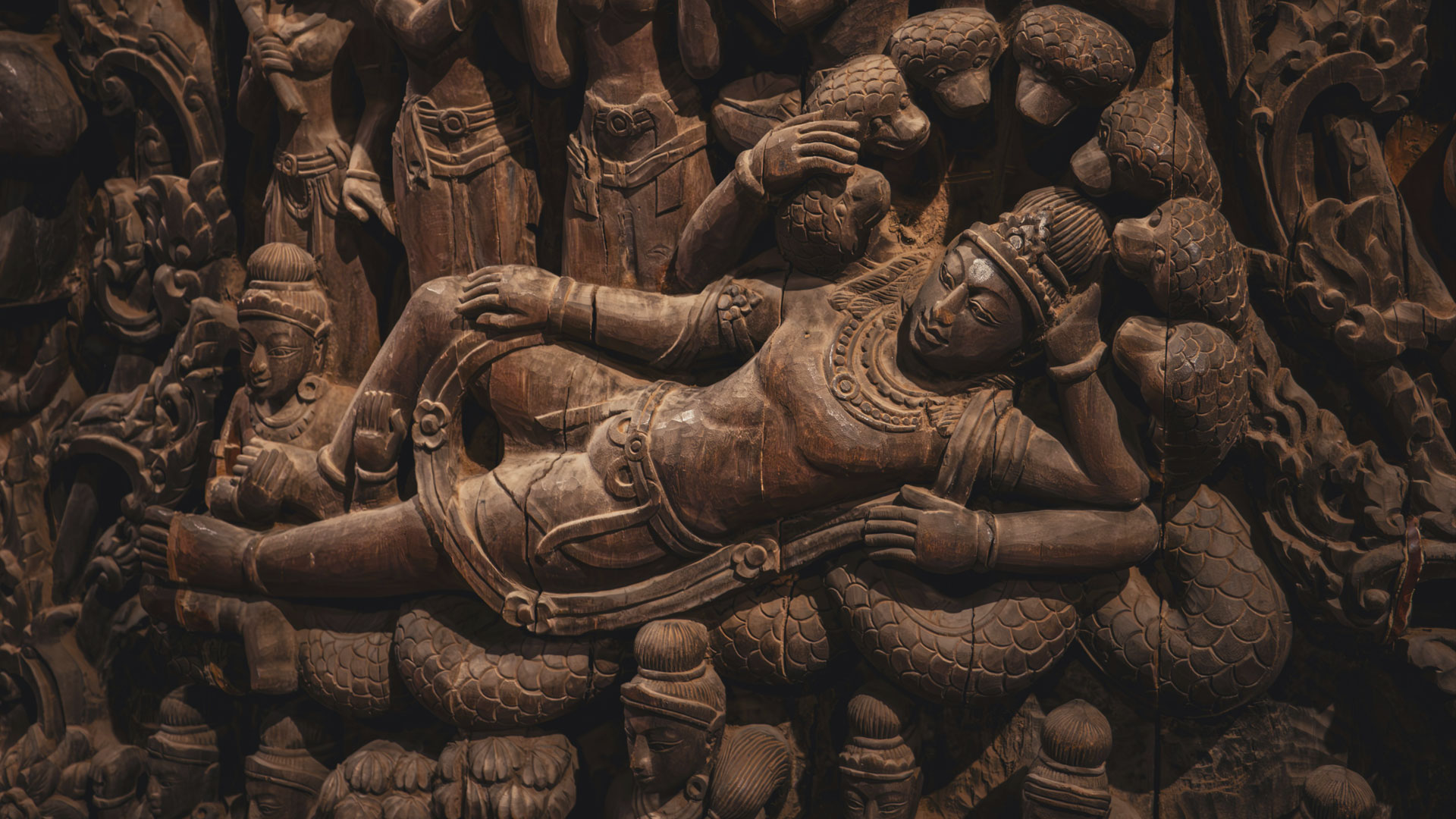
The “Sleep of Vishnu,” known as Yoga Nidra or cosmic slumber, is a profound Hindu concept representing the cyclical resting phase of the universe. During this period, Lord Vishnu rests on the serpent Shesha in the Ocean of Milk, transitioning the cosmos between periods of creation and dissolution.
3. Two Schools, One Practice
Yoga Nidra is not a single unified method. Like many great traditions, it has branched over time into different streams, each with its own emphasis, its own technique and its own depth.
Two schools in particular shape today’s understanding of Yoga Nidra: the tradition of Swami Rama at the Himalayan Institute, and the therapeutically oriented school of Swami Satyananda Saraswati at the Bihar School of Yoga. Both paths lead inward, but they travel that path in different ways.
4. Swami Rama & the Himalayan Institute
Swami Rama (1925–1996) was one of the most influential yoga masters of the 20th century. As founder of the Himalayan Institute in Honesdale, Pennsylvania, he brought the wisdom of the Himalayan tradition to the West in a way that was both spiritually profound and scientifically verifiable.
Raised in the high Himalayas, Swami Rama received his training from various masters of the Himalayan tradition — a lineage rooted in direct connection to the ancient Vedantic and Tantric transmission. His approach to Yoga Nidra is inseparable from this tradition: not as an isolated technique but as an integral part of a comprehensive meditative path.
The 61-Points Practice – Shavayatra
The centrepiece of Swami Rama’s Yoga Nidra approach is the 61-Points Practice, known in Sanskrit as Shavayatra — literally “an inner pilgrimage through the body”. It is an extension of an older 31-point practice and guides awareness sequentially through 61 specific points in the body, beginning at the space between the eyebrows, moving through the throat centre, shoulders, elbows, wrists and fingertips, through the entire trunk, down the legs to the tips of the toes, and back up to the crown.
These points are not arbitrary. They correspond to the intersection points of the subtle energy channels (Nadis) and the zones of highest nervous density in the body. Their systematic activation through pure attention brings the mind into a state of deep stillness, without effort, without concentration in the conventional sense. Swami Rama recommended this practice both as preparation for Yoga Nidra and as a standalone meditative form.
With advanced practice, it is recommended to visualise a golden or blue light at each of the 61 points instead of numbers — a development that cultivates the luminous quality of inner awareness.
Shitali Karana – Preparing the Nervous System
The 61-Points Practice is often paired with Shitali Karana — a breathing technique from the Tantric tradition that prepares the nervous system for deeper states of consciousness. Through the conscious slowing and refinement of the breath, the transition from beta to alpha and theta brain waves is supported. The mind finds its way inward before the actual Yoga Nidra practice has even begun.
Science and Tradition in Dialogue
Swami Rama was one of the first yoga masters to actively engage with Western science. In laboratory studies at the Menninger Institute in Kansas, USA, he demonstrated under controlled conditions the voluntary control of heart rate, blood pressure, body temperature and brain wave patterns — physiological processes previously considered entirely involuntary. In one widely cited experiment, he deliberately slowed his heartbeat to a level that instruments initially interpreted as cardiac arrest.
These documentations had far-reaching consequences. They played a significant role in awakening Western scientific interest in yoga, meditation and altered states of consciousness, and paved the way for the brain wave research that today helps explain how Yoga Nidra works.
Core of the approach: Spiritual deepening, meditative self-knowledge and the direct experience of Purusha — pure consciousness beyond all thoughts and forms. Yoga Nidra as a path to the Self.

Swami Rama, founder of the Himalayan Institute
5. Swami Satyananda Saraswati & the Bihar School of Yoga
Swami Satyananda Saraswati (1923–2009) is the person to whom the modern therapeutic form of Yoga Nidra owes the most. As founder of the Bihar School of Yoga in Munger, India, he drew on the ancient Tantric teachings to develop a precise, reproducible method with eight clearly defined stages that systematically guide any practitioner into the state of yogic sleep.
The Eight Stages according to Swami Satyananda:
- Internalisation — preparation of body and mind, settling into stillness
- Sankalpa — planting an inner resolve at the beginning of practice
- Rotation of Consciousness — systematic movement of awareness through the body
- Breath Awareness — observation of the natural breath rhythm
- Pairs of Opposites — conscious experience of contrasting sensations
- Visualisation — guided inner imagery in the Chidakasha (inner space)
- Sankalpa — repetition of the resolve at the close of practice
- Externalisation — gentle return to the waking state
What makes this approach remarkable is its therapeutic precision. Each stage has a clearly describable psychophysiological effect. The rotation of consciousness, for example, systematically activates the sensorimotor cortex — the brain region corresponding to the Homunculus, the body’s inner map. Experiencing pairs of opposites such as heat and cold, heaviness and lightness, trains emotional regulation and the capacity to observe inner states without being overwhelmed by them — a core competence in trauma work and in the treatment of chronic stress.
Satyananda’s method has been developed further by students worldwide. Swami Janakananda founded the Scandinavian School of Yoga in 1970 and initiated some of the first systematic research into the effects of Yoga Nidra on brain wave patterns. Richard Miller developed the iRest protocol on the basis of Satyananda’s method — an adaptation now used in US military veterans’ hospitals for the treatment of PTSD (Post-Traumatic Stress Disorder).
Core of the approach: Therapeutic depth, systematic method, access to the unconscious. Yoga Nidra as a healing tool.
6. Sankalpa — the Seed You Plant
Sankalpa is a Sanskrit term composed of san (highest truth) and kalpa (resolve, vow). In the context of Yoga Nidra, it refers to a short, positively formulated inner intention — a sentence planted deep into consciousness at precisely the moment when the mind is most receptive.
And that timing is everything. Sankalpa is set not at a random moment but twice: once shortly after the beginning of practice, when the nervous system begins to soften, and once again near the end, when the mind rests in a state of deep stillness. In this in-between state, at the threshold between waking and sleeping, the layers of resistance, rational control and inner critic are weakened. The resolve can penetrate directly into the unconscious, like a seed into prepared soil.
Swami Satyananda described it this way:
“A Sankalpa made during Yoga Nidra can become a truth and a reality in your life.”
In therapeutic practice, this means: Sankalpa is neither wishful thinking nor affirmation in the superficial sense. It is a precise alignment of the deepest will — a few words that set a direction. For people living with chronic pain, for instance, the Sankalpa is not formulated as a wish for freedom from pain but as an orientation toward acceptance: “I am greater than the pain” or “I am at peace with my body.” This shift from resistance to acceptance corresponds to what modern pain research identifies as one of the decisive factors in long-term pain reduction.
Sankalpa is an element found exclusively in the Satyananda tradition. In Swami Rama’s approach there is no Sankalpa. The focus there rests on meditative deepening and the direct experience of the Self.

7. What Happens in the Body and Brain during Yoga Nidra?
To understand why Yoga Nidra works so profoundly, it helps to look at the neurophysiology. What occurs in the body and brain during a session is remarkably well described and corresponds in large part to what the tradition has articulated for centuries.
Brain Waves — the Journey Inward
In the waking state, the brain works predominantly in beta waves (14–30 Hz) — focused, analytical, sometimes tense. As relaxation deepens, the waves slow to alpha (8–13 Hz) — a state of calm wakefulness in which creativity and learning capacity increase. Moving deeper still, theta waves (4–7 Hz) emerge — that half-sleep state associated with intuitive perception, emotional processing and access to the unconscious. In deep sleep, delta waves (0.5–3 Hz) dominate.
What makes Yoga Nidra remarkable: the practice consciously guides the brain through all these levels, from beta through alpha and theta to delta, while awareness remains awake. This state — delta waves with conscious awareness — is neurophysiologically extraordinary and corresponds to what the Upanishads describe as Prajna. EEG measurements taken during Yoga Nidra sessions confirm exactly this transition.
The Parasympathetic Nervous System
Yoga Nidra consistently activates the parasympathetic nervous system — the part of the autonomic nervous system responsible for rest, recovery and healing. In daily life, many people spend too much time in sympathetic dominance — the so-called fight-or-flight mode. Chronic stress, sleep difficulties, high blood pressure, digestive complaints and exhaustion are frequently the direct consequences of this sustained activation.
Yoga Nidra works against this dysregulation. Through guided awareness, breathing rate, heart rate and muscle tone all decrease. Heart rate variability (HRV) — an important marker of nervous system resilience and regulatory capacity — improves.
At the same time, hormonal parameters shift: cortisol decreases while dopamine levels normalise. According to Swami Satyananda, one hour of Yoga Nidra can be as restorative as four hours of ordinary sleep — a claim increasingly supported by neurophysiological measurement.
The Sensorimotor Cortex & Body Rotation
The rotation of consciousness — the systematic movement of awareness through the body parts — precisely activates the sensorimotor cortex, the brain region that holds the body’s inner map.
This activation without physical movement is neurophysiologically significant: it enhances body awareness, releases patterns of muscular tension and builds a deep connection between consciousness and body, particularly relevant in work with trauma, chronic pain and dissociative states.
8. What the Research Says
Scientific investigation of Yoga Nidra has grown substantially over recent decades. The available studies vary in methodological rigour, from clinical case reports to randomised controlled trials. Nevertheless, they paint a consistent picture.
Stress & Wellbeing
A randomised controlled trial conducted at the Bundeswehr University Munich examined the effects of a daily practice of just 11 minutes of Yoga Nidra over 30 days. The results were remarkable: stress decreased measurably, sleep quality improved, positive affect and life satisfaction rose — all with a daily practice time that could hardly be shorter. The study demonstrates that it does not take hours to make a difference.
Blood Pressure & Cardiovascular Health
A clinical study with 40 individuals with mild hypertension examined the effects of 30 minutes of Yoga Nidra daily over 15 days. Systolic and diastolic blood pressure fell significantly, as did pulse and breathing rate. Stress, anxiety and anger also decreased measurably. The described mechanism: relaxation of the autonomic nervous system leads to vasodilation – blood vessels widen, cardiac load decreases, blood pressure follows.
Further review papers report reduced serum cholesterol levels in cardiac patients, sustained blood pressure reduction beyond the session itself, and lowered stress hormones including cortisol, aldosterone and adrenaline.
Sleep Quality
A clinical study with cancer patients showed a statistically significant improvement in sleep quality following regular Yoga Nidra practice — measured using the Pittsburgh Sleep Quality Index, one of the most established scientific instruments for assessing sleep. The improvements were clear and consistent, not incidental.
Pain & Migraine
Several studies document a reduction in painkiller use among migraine patients through regular Yoga Nidra practice. In one US-based investigation, around 81% of participants reported noticeable pain relief. Similar findings emerge from studies combining Yoga Nidra with biofeedback.
Asthma
Multiple clinical reports document reduced frequency and severity of asthma attacks following regular practice. A proportion of participants were able to reduce their medication, and in individual cases complete discontinuation was possible. Functional improvements in breathing capacity were documented.
EEG & Neurophysiology
A review study that evaluated five research papers alongside thirty expert interviews reported consistent shifts in brain wave patterns toward alpha and theta during practice — a clear sign of parasympathetic dominance and deep relaxation alongside waking awareness.
In context: The strongest evidence currently exists for stress reduction, sleep improvement and blood pressure lowering. The evidence base for PTSD (Post-Traumatic Stress Disorder), burnout and chronic pain is promising and growing. The studies here are still methodologically varied, but clinical reports are consistent.

9. My Own Path with Yoga Nidra
I want to be honest: the therapeutic branch of Yoga Nidra did not convince me from the start.
Before completing my Yoga Nidra teacher training with Ram Jain, I had already read widely and practised for years in the Himalayan tradition of Swami Rama. The 61-Points Practice was familiar to me, and the spiritual dimension of Yoga Nidra had touched me from the start. But toward the Satyananda school — and particularly toward the Sankalpa — I was initially sceptical. It felt too close to autosuggestion, too much like loading the mind with expectations. Yoga, as I understood it, was supposed to be the opposite: letting go, not wanting.
What I had not yet understood was that I held a mistaken idea of what Sankalpa actually is.
The turning point came during a Yoga Therapy workshop with Raphael Moussa — a German teacher of integrative Ayurveda and yoga therapy who weaves Yoga Nidra deeply into his therapeutic work. For the first time, I understood that a genuine Sankalpa is not an expectation but an orientation. Not wishful thinking, but the quiet naming of an inner truth.
Later, deepening my practice with Ram Jain, the full framework of the Satyananda tradition opened up to me — and with it, a practice that felt fundamentally different from anything I had known before. Through hundreds of hours of personal practice and a growing capacity to genuinely reach the deeper layers of the unconscious, things began to dissolve that I had long accepted as unchangeable. Old traumas. Deep-rooted patterns. And finally, a tinnitus I had carried with me for over twenty years, which gradually fell away.
That showed me, in a way no theory could replicate, what power lies in the unconscious — and what becomes possible when one has learned to truly reach it.

Yoga Nidra is for almost anyone. You simply lie down and follow a voice.
10. Who is Yoga Nidra for?
The answer is: almost anyone. Yoga Nidra requires no physical fitness, no prior experience with meditation and no particular spiritual orientation. You simply lie down and follow a voice.
The practice is especially valuable for people in the following situations:
Chronic Stress, Exhaustion & Burnout
When someone has been under sustained pressure, the nervous system gradually forgets how recovery even feels. The sympathetic nervous system stays activated — at night, on holiday, everywhere. Yoga Nidra is one of the few practices that guides the nervous system back into parasympathetic mode not through willpower but through guided awareness. Without effort. Without having to get anything right.
Sleep Difficulties
An overactive mind cannot be commanded to be quiet. Yoga Nidra bypasses that resistance by engaging the mind without burdening it. Regular practice measurably improves sleep onset, sleep depth and the subjectively experienced quality of rest.
Trauma & Emotional Burden
Yoga Nidra is not a confrontational approach. It forces nothing to the surface. Instead, it creates a safe inner space in which the nervous system learns to regulate itself — a fundamental prerequisite for any deeper processing. The systematic body rotation and the experience of pairs of opposites in particular train the capacity to observe intense inner states without being overwhelmed by them.
Chronic Pain
Pain is not only a physical signal — it is also a state of consciousness. Yoga Nidra shifts the relationship to pain by strengthening the observer: that dimension of awareness that perceives without judging. Combined with a well-chosen Sankalpa — an orientation of acceptance rather than resistance — this practice can meaningfully change both the experience of pain and the capacity to live well alongside chronic conditions.
Those on a Spiritual or Meditative Path
Yoga Nidra is not only therapy. For those looking to deepen their meditation practice, it is an invaluable preparation — training the capacity to remain awake in deep states of consciousness and opening doors that remain closed in ordinary waking awareness.
Anyone Who Wants to Come Home to Themselves
Sometimes there is no major diagnosis, no obvious crisis. Just that quiet feeling of no longer being quite present to oneself. Of functioning, but not really living. For this too, Yoga Nidra offers a path back to one’s own centre, one’s own stillness, one’s own Self.
Yoga Nidra & Personal Guidance
Yoga Nidra is not a cure-all. And it does not replace medical or psychotherapeutic treatment for serious conditions. But as a complementary practice — used regularly and with intention — it is one of the most accessible and at the same time most profound tools I know in my work.
If you feel that Yoga Nidra might be something for you — individual, tailored to you, in your language — I look forward to hearing from you.
Sources
- Moszeik, E. N., von Oertzen, T. & Renner, K.-H. (2018). Effectiveness of a Short Yoga Nidra Meditation on Stress, Sleep, and Well-being: A Randomized Controlled Trial. Bundeswehr University Munich. Presented at the 3rd Conference of the DGPPF, Ruhr University Bochum.
- Kumar, K. Effect of Yoga Nidra on Hypertension and other Psychological Correlates. Bihar School of Yoga.
- Effectiveness of Yoga Nidra on Quality of Sleep among Cancer Patients. Clinical study, full title available in project documentation.
- Yoga Nidra and Its Therapeutic Applications. Review of therapeutic applications.
- Yoga Nidra as a Stress Management Intervention Strategy. Review including EEG findings (Dwivedi & Singh).
- Reversing Ischemic Heart Disease through Yoga Nidra. Review of cardiovascular effects.